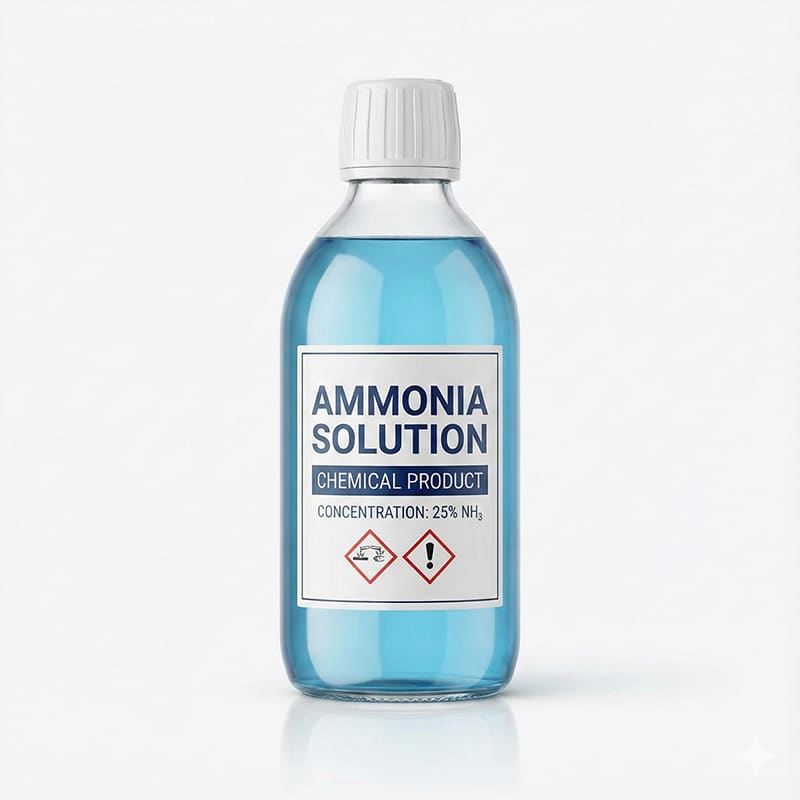
Key takeaways
- Anhydrous ammonia (NH3) boils at about −33 °C, so it is transported either refrigerated at atmospheric pressure or as a liquefied gas under pressure.
- Most ammonia is used to make nitrogen fertilizers such as urea, ammonium nitrate and ammonium phosphates.
- Ammonia is toxic and corrosive. Safe handling depends on correct materials, leak detection and trained personnel.
Ammonia is one of the most produced chemicals on the planet. It is made mainly by the Haber-Bosch process, combining nitrogen from the air with hydrogen, usually produced from natural gas. "Anhydrous" simply means ammonia without water, as opposed to aqueous ammonia (ammonium hydroxide solution).
Key properties
| Property | Value (approximate) |
|---|---|
| Chemical formula | NH3 |
| Boiling point at 1 atm | −33.3 °C |
| Liquid density at −33 °C | about 0.68 kg/l |
| Vapour pressure at 20 °C | about 8.6 bar |
| Nitrogen content | about 82% by weight |
| Flammable range in air | roughly 15% to 28% |
With about 82% nitrogen, ammonia is the most concentrated nitrogen fertilizer available, which is why it is also applied directly to soil in some markets.
Grades and typical specification
Commercial anhydrous ammonia is usually specified with a minimum purity of 99.5% by weight, with limits on water and oil. Refrigeration-grade and high-purity grades have tighter limits. Interestingly, a small amount of water is sometimes intentionally kept in ammonia stored in carbon steel pressure vessels, because it helps inhibit stress corrosion cracking. Always agree the exact specification in the contract.
Main uses
- Fertilizers: the large majority of ammonia becomes urea, ammonium nitrate, ammonium sulfate, ammonium phosphates or is applied directly.
- Industrial chemicals: nitric acid, caprolactam (for nylon), acrylonitrile, amines and many intermediates.
- Refrigeration: ammonia (R-717) is an efficient industrial refrigerant with zero ozone depletion potential.
- Emission control: reducing NOx in power plants and industrial boilers.
- Energy transition: ammonia is being developed as a hydrogen carrier and as a marine fuel.
How ammonia is transported
Fully refrigerated
Large seaborne volumes move on fully refrigerated gas carriers at about −33 °C and near-atmospheric pressure. Terminals store ammonia in large refrigerated tanks with reliquefaction systems.
Semi-refrigerated and pressurized
Smaller cargoes move on semi-refrigerated or pressurized gas carriers. On land, ammonia is carried as a liquefied gas under pressure in road tankers, rail tank cars and ISO tank containers.
Dangerous goods classification
For international transport, anhydrous ammonia is UN 1005. Under international sea and road rules it is classified as a toxic gas with a corrosive subsidiary hazard, so documentation, placarding and crew training must follow the applicable regulations.
Hazards and safety essentials
- Toxicity: ammonia vapour irritates eyes and lungs at low concentrations and is dangerous at high concentrations. Its sharp smell gives early warning, but it should never be relied on as the only detection method.
- Cold burns: liquid ammonia evaporates rapidly and can cause frostbite on contact.
- Material compatibility: ammonia attacks copper, zinc and their alloys such as brass. Use compatible steel equipment and fittings.
- Emergency planning: water spray can absorb ammonia vapour, but run-off must be contained. Facilities need gas detectors, wind indicators, escape routes and suitable respiratory protection.
Always share the supplier's Safety Data Sheet with transport, terminal and end-user teams before the first delivery.
Inspection and quantity measurement
For refrigerated cargoes, quantity is calculated from tank gauging, temperature and pressure readings, using agreed calculation tables. Quality samples are taken under strict safety procedures. An independent inspector should witness both and issue certificates of quality and quantity.
Ammonia from Aban Chemical
Aban Chemical coordinates supply of anhydrous ammonia for fertilizer and industrial buyers, including specification review, inspection and logistics. Visit the ammonia product page, see how ammonia becomes urea, or request a quote.